suncost labs

ASTRARIUM

attuned to the sky

Astrarium computes where the planets are for any moment and place and turns their arrangement into synth settings. It also reads signals about the world: rain on the radar over you, the tides, the earthquakes of the last day, and solar activity.

The positions of the celestial bodies are predictable and repeatable; the combination of signals from the other are not so predictable. You mix structure and noise to make a unique sound tied to a time and place.

mobile beta

Astrarium is coming to Android and iOS.

Join the private beta and I’ll add you manually when a build is ready. Windows is coming soon.
Interested in

Your email is used only to manage this beta list and contact you about access.

AU · VST3 · Standalone  ·  macOS 11+ (Apple Silicon & Intel)  ·  notarized  ·  early access: 1.0 upgrade included  ·  Windows coming

IIIIIIIVVVIVIIVIIIIXXXIXIIascMercuryVenusMarsJupiterSaturnUranusNeptuneMoon
the sky over Greenwich · 2026 · IX · 12
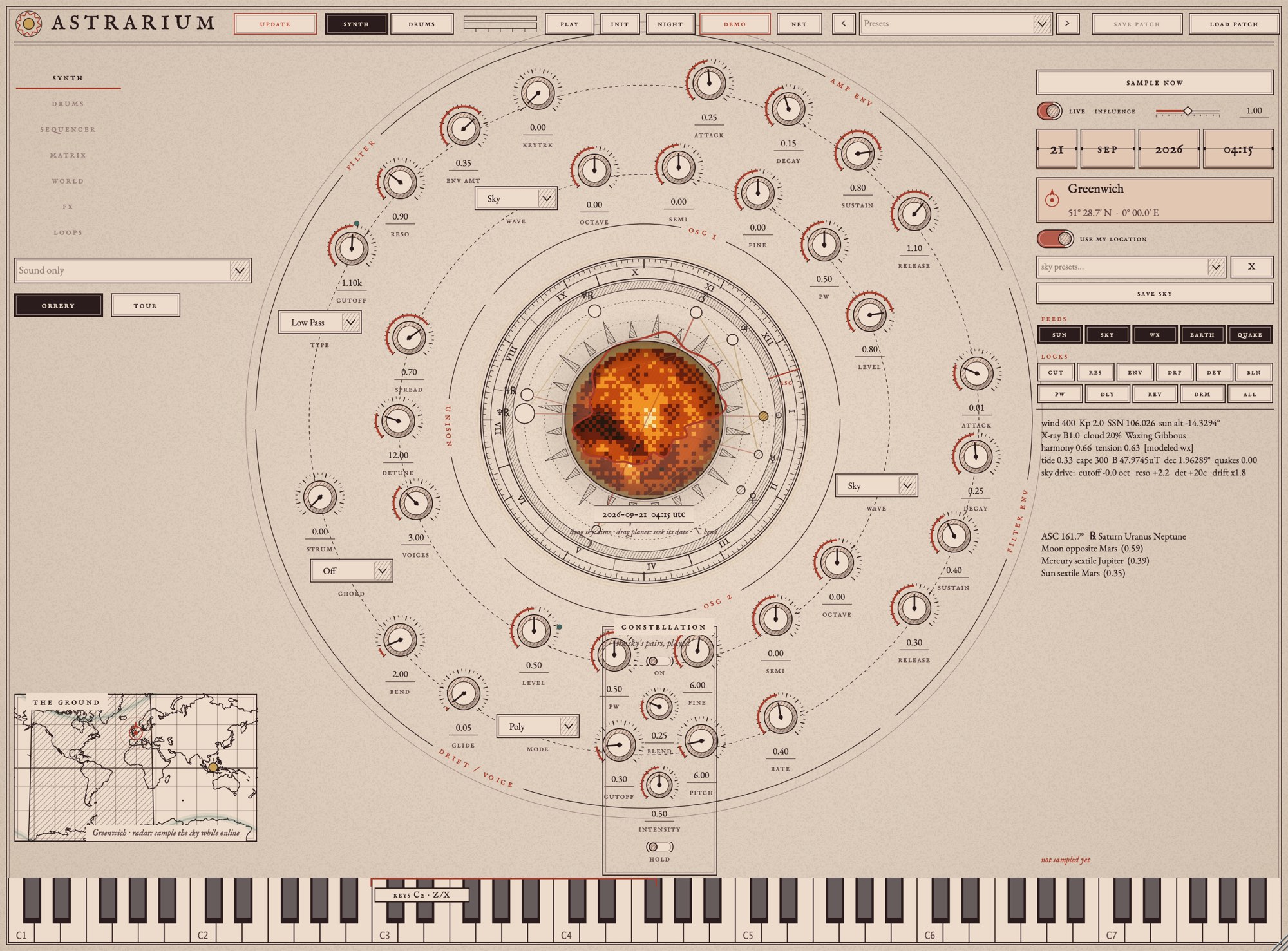
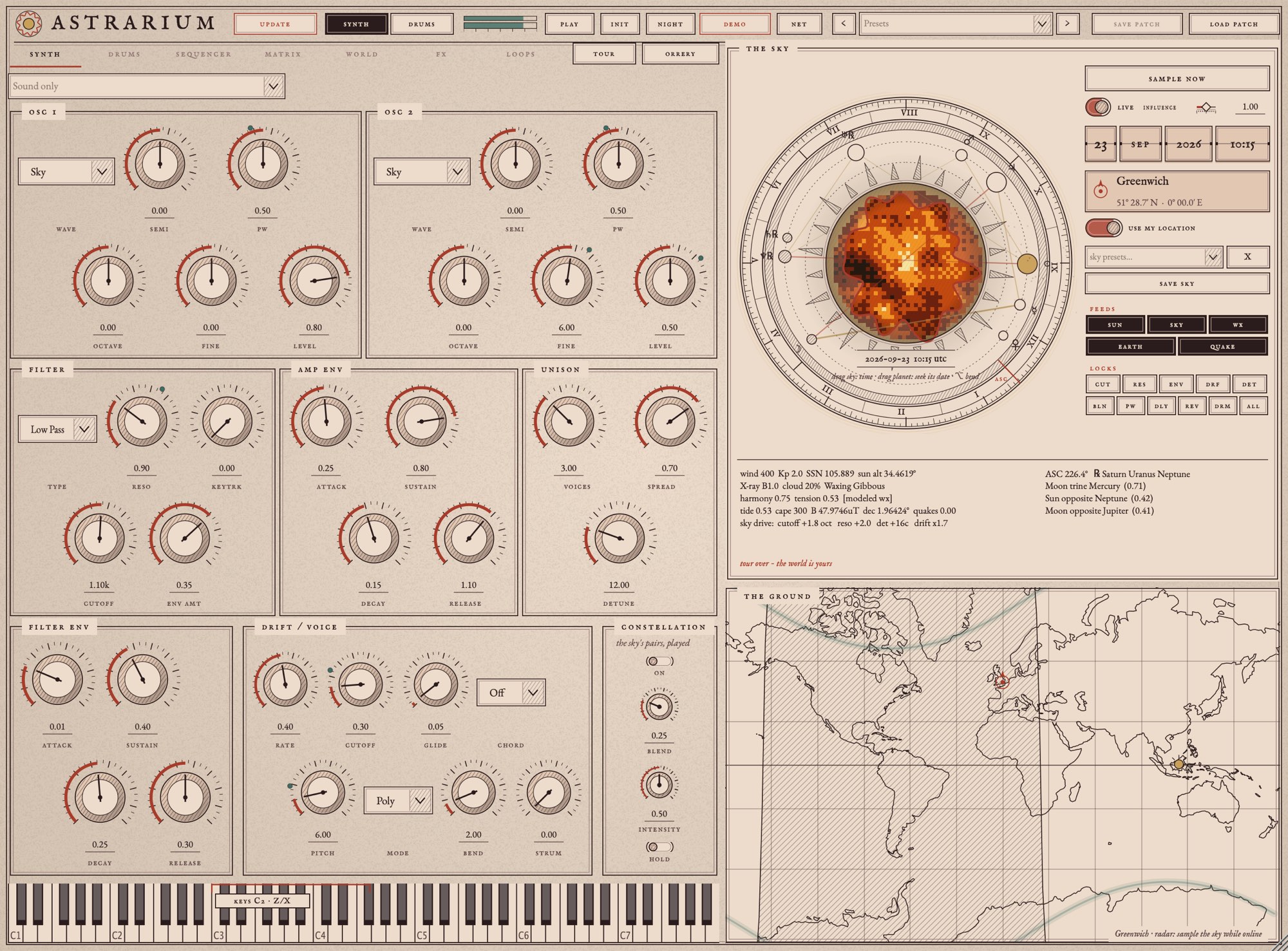
The Astrarium interface: synthesizer controls on the left, the computed sky wheel and world map on the right
The main window. The red ring around the sun is the shape of the sound, built from the positions of the planets.

Listen

Example A0:52
Example B0:47
Example C0:46

sketches

Example D0:21
Example E0:18
Example F0:21

All of these were made in the app.

How the sky becomes sound

the planetsthe shape of the sound

The sound is built by adding nine sine waves together, one for each body in the solar system. Each body owns a fixed place in that stack, set by how fast it orbits: Neptune, the slowest, is the lowest wave, and the Moon, the fastest, is the highest. A body's position along the zodiac shifts its wave forward or back, so the shape changes continuously as the planets move. Its height above your horizon sets how strong it is, along with its general prominence and any alignments it is in. Two bodies in conjunction put their waves in step with each other. The red ring around the sun is the result.

the aspectstension and harmony

Planets sit at angles to each other, and certain angles matter. Squares and oppositions are tense: they sharpen the sound and unsettle its tuning. Trines and sextiles are easy: they widen the reverb and steady the drift. The lines drawn across the circle show the alignments in force, and the readout names the three strongest.

the sunbright by day, dark and echoing at night

The position of the sun changes the sound. At noon it is bright and dry. At midnight it is dark, with a far longer echo. At sunset the two sides of the echo fade at different rates, so dusk arrives in stereo. One slider sets how strongly the sky pushes, and any part of it can be switched off.

the weather and the groundlive, and never the same twice

The app reads the weather at your position. Rain on the radar becomes a wash of sound. A storm overhead brings thunder, near or distant. The tides move the delay times. Earthquakes from the past day rumble underneath. This half of the instrument changes from day to day. Without a connection the app models the weather instead.

the tour, step by stepnine stops, each with the same tune

The app includes a guided tour that moves you around the world and through the calendar, asking you to play at each stop. Nine of them are below. The same short tune plays at every one, so the difference is the sky and nothing else.

Two minutes: the nine stops in order, with the melody played at each. Or take them one at a time below.

Astrarium during the tour step Starting from a clean sound
Starting from a clean sound
Astrarium during the tour step Noon on the equator
Noon on the equator
Astrarium during the tour step Midnight, on the far side
Midnight, on the far side
Astrarium during the tour step Sunset
Sunset
Astrarium during the tour step Tokyo, a shaking ground
Tokyo, a shaking ground
Astrarium during the tour step Singapore, a rainy coast
Singapore, a rainy coast
Astrarium during the tour step The next opposition
The next opposition
Astrarium during the tour step The next trine
The next trine
Astrarium during the tour step Influence
Influence

What it does

I.Sky oscillatorevery planet adds a layer

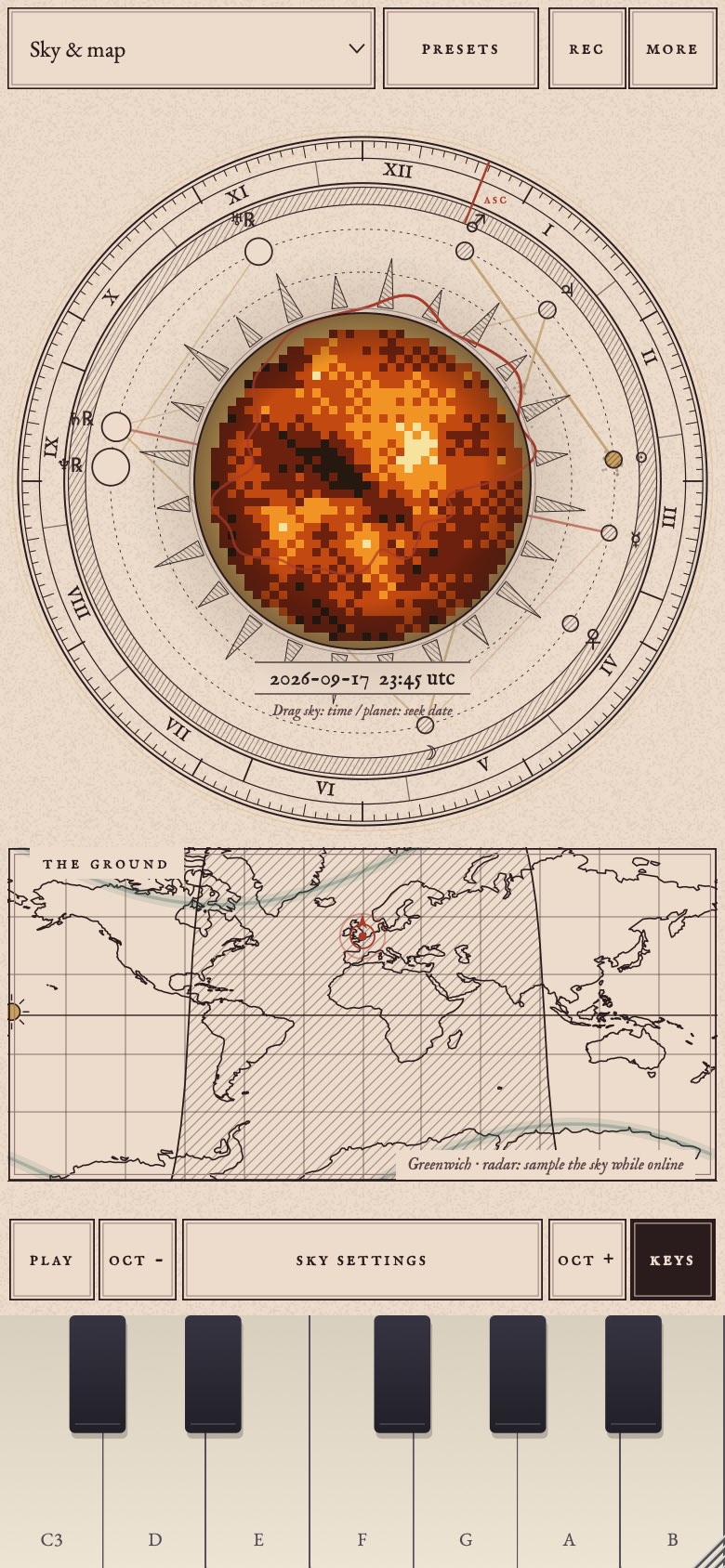
Each body in the solar system owns one wave in the stack, low for the slow outer planets and high for the fast inner ones. Its position shifts that wave, and its height above your horizon sets its strength. Drag the wheel to change the date. Drag a planet and the app finds the date it was in that position.

II.Constellationplanets paired into sounds

A second instrument. The app takes the planets most strongly aligned at that moment and gives each one its own voice. Their alignment determines how they will interact: sitting on the same note, answering each other, holding a chord, clashing into something metallic, or trading back and forth. Two different pairs at the same angle sound different, because the voices differ. It stays off until you turn it on, and a single slider mixes it against the normal sound.

III.Synthesizertwo oscillators, a solar model, two echoes

Two oscillators, plus a third built from a model of the sun's own resonance. Chords, a filter, envelopes, up to seven voices stacked per note, slow tuning drift, a stereo delay and two reverbs. One is an ordinary studio plate. The other opens at night and closes by day, following the sky above you.

IV.Drums and sequencera drum kit and a step sequencer

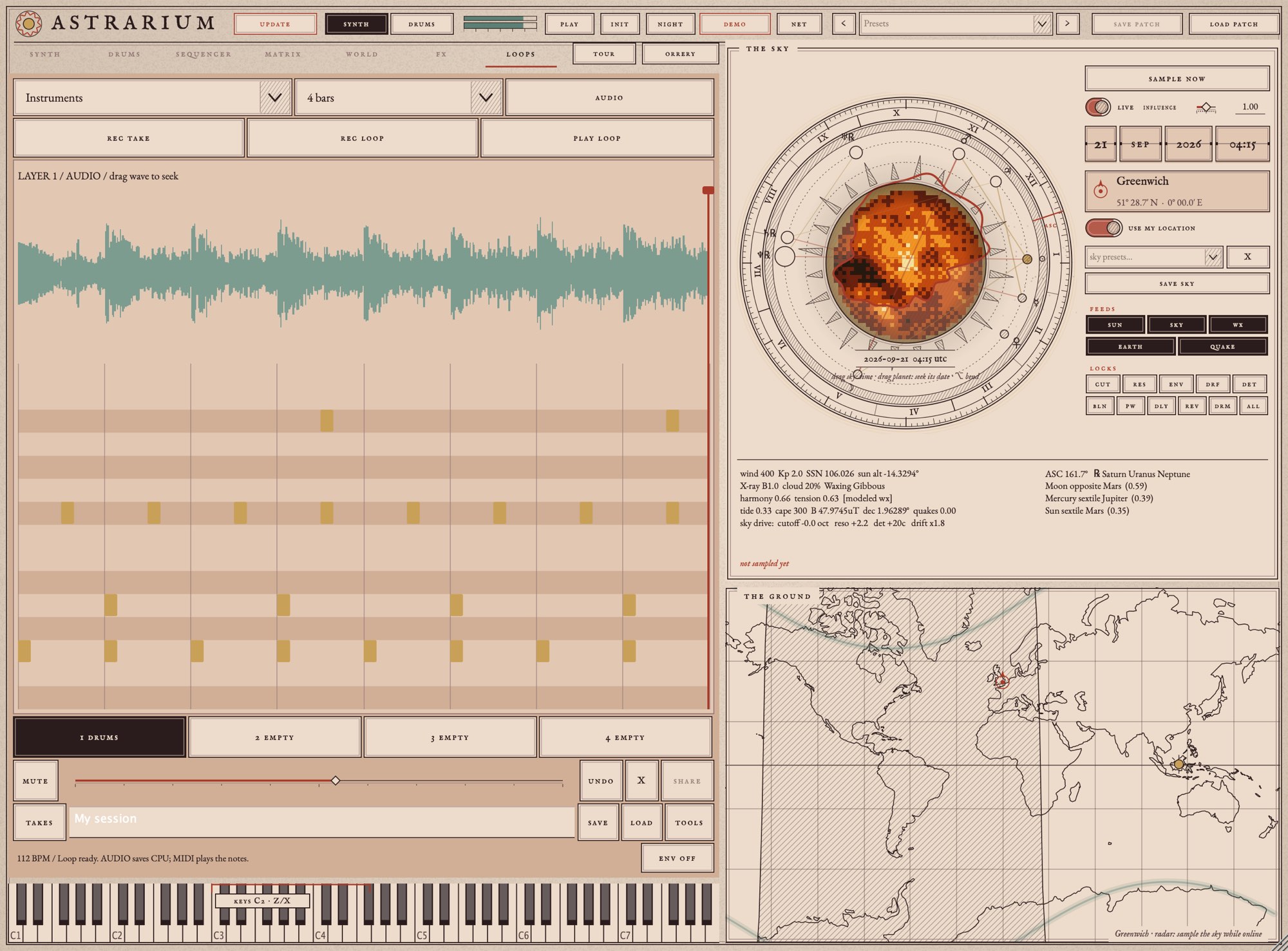
A drum kit you can shape, with drive, crunch and tape wobble. A step sequencer holding four chainable patterns of 8 to 32 steps, with a bass line locked to the key. One button writes a pattern from the current sky. It follows your DAW's tempo or runs on its own.

V.Mod matrix and MPEsend any sky reading to any control

Eight slots route any reading from the sky, such as solar wind, moon phase, tides or seismic activity, to any control in the synth, in either direction. MPE keyboards get per-note bend, pressure and timbre.

VI.Environmentrain, thunder, tides and earthquakes

A slow wobble at the Earth's own resonant hum. Rain from the radar above you. Thunder when a storm is genuinely overhead, near or distant. The rumble of recent earthquakes. And a slot for your own recordings underneath it all.

VII.Offline and privateworks offline, and lists what it contacts

It works without an internet connection. The planets are calculated on your own machine either way, and offline the app models the weather instead. One panel lists every site it can contact, each with its own switch. No tracking, no account, no sign-in. Your licence is a file that keeps working.